

The problem: an AI can’t backtest a sentence
On 9 April 2025 the S&P 500 had fallen twelve percent in four sessions. At 9:37 Eastern, Donald Trump posted: “THIS IS A GREAT TIME TO BUY!!! DJT”. At 1:18 that afternoon he paused most of the new tariffs. SPY closed up 10.5%.
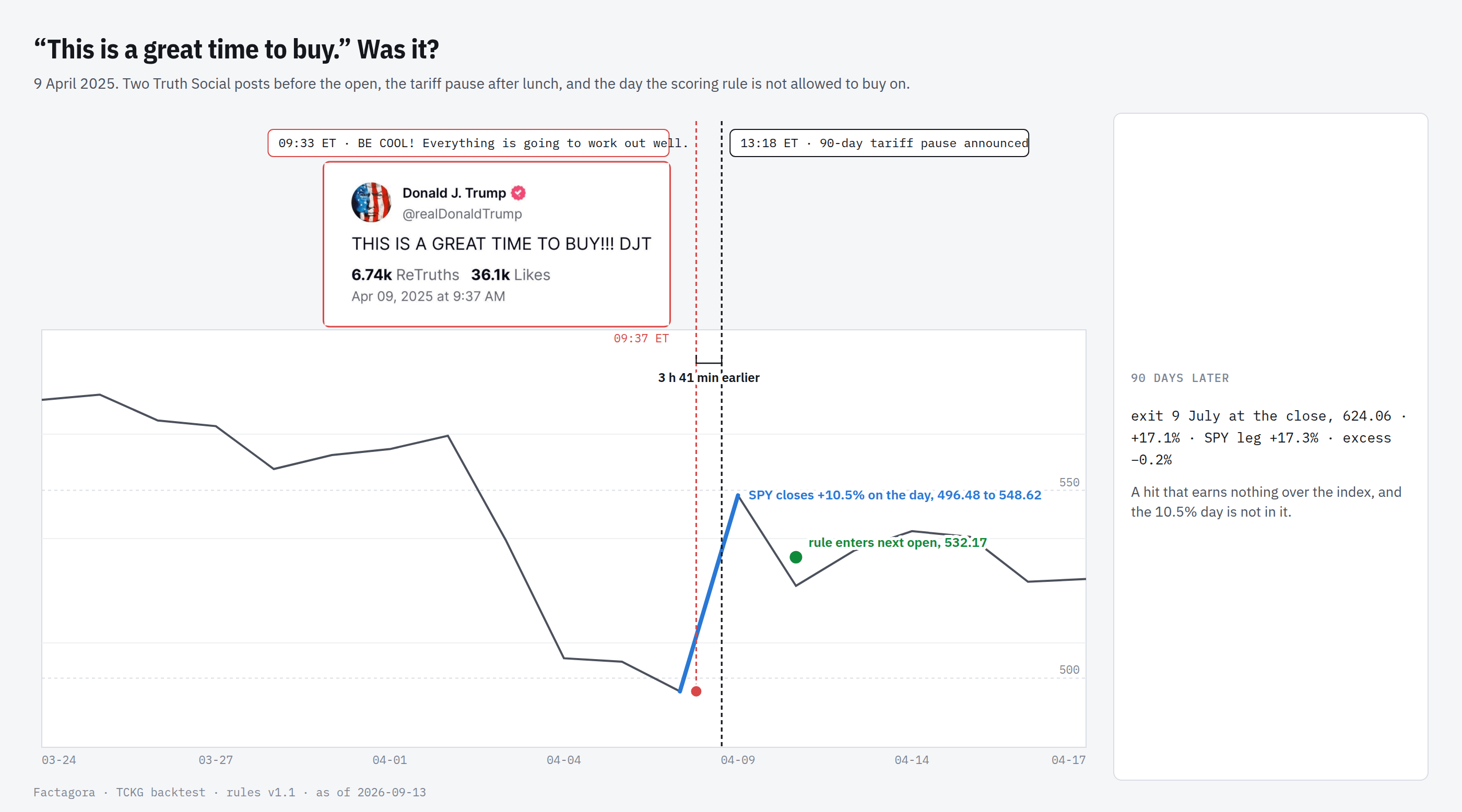
Was it a good call? Scored honestly, from the next open when anyone could act, it earned nothing over the index. But ask a language model and it already knows what happened at 1:18. It cannot forget the afternoon.
We tested this on hundreds of dated market calls. Asked without a date, 11% of the dates the model cited were in the wrong year. Asked why a call worked, it gave true facts, from later, about a different company. And every call has two verdicts: on the day it was due, and today. For 28% of calls they disagree, and the model cannot tell which one you meant.
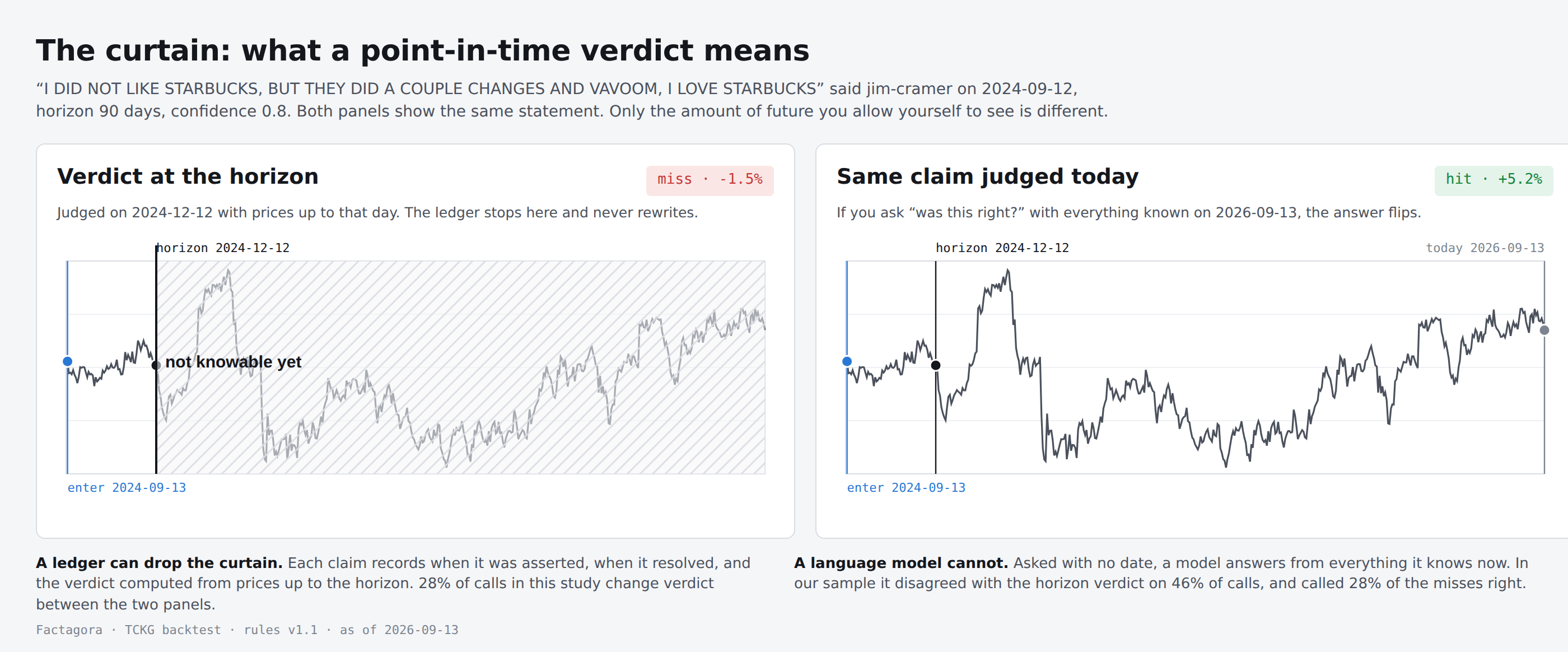

Agreement with the price record: no date 53.1%, as-of date 52.2%, with Google Search 70.0%. Losing calls it called winners: 30.5%, 67.6%, 20.4%.
Without a date, it is a coin flip. With web search, 70%, and it still calls one in five losers a win. The model is not the problem. The memory is: it stores sentences, not when they were said or what they rested on.
Our approach: a memory with a clock
At Factagora we build a Temporal Causal Knowledge Graph (TCKG). Every claim keeps when it was said, when it resolves, what it rests on, and every verdict with the date it was made. Ask it about any day and it answers with only what was knowable that day. One person’s TCKG is what we call a brain.
The use case: 14 brains, two years, one rule
We built brains for Donald Trump and 13 of the most followed US finance YouTubers: 16,150 dated market claims, each linked to the post or the second of video it came from. Then we backtested every call over the past two years with one fixed rule: enter at the next open, exit at the speaker’s horizon or 90 days, measured against SPY over the same dates.
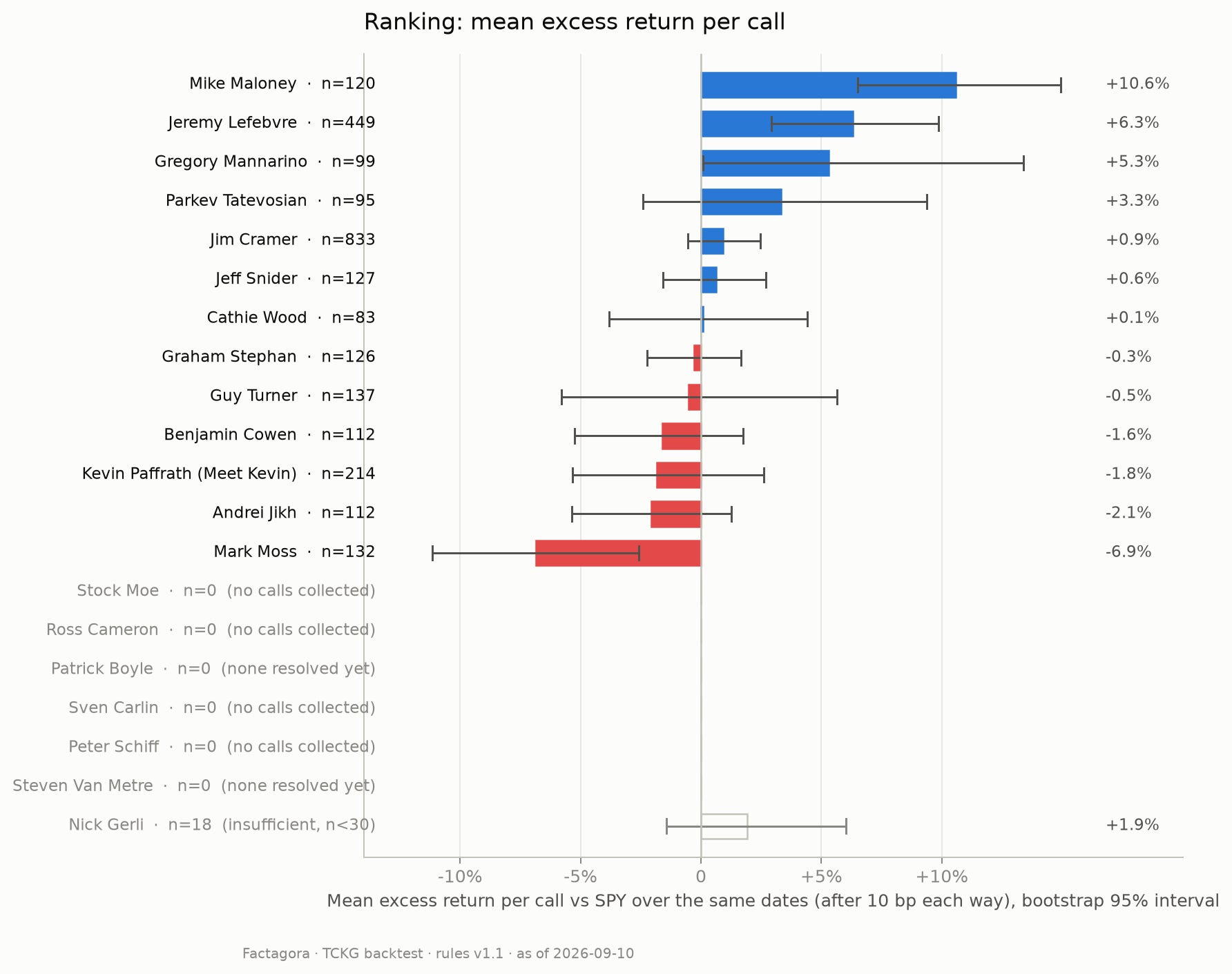
Mike Maloney: 120 calls, +10.6% per call, 62% hit rate
Jeremy Lefebvre: 449 calls, +6.3% per call, 60% hit rate
Gregory Mannarino: 99 calls, +5.3% per call, 69% hit rate
Parkev Tatevosian: 95 calls, +3.3% per call, 53% hit rate
Jim Cramer: 833 calls, +0.9% per call, 53% hit rate
Jeff Snider: 127 calls, +0.6% per call, 50% hit rate
Cathie Wood: 83 calls, +0.1% per call, 54% hit rate
Graham Stephan: 126 calls, -0.3% per call, 50% hit rate
Guy Turner: 137 calls, -0.5% per call, 50% hit rate
Benjamin Cowen: 112 calls, -1.6% per call, 41% hit rate
Kevin Paffrath: 214 calls, -1.8% per call, 43% hit rate
Andrei Jikh: 112 calls, -2.1% per call, 46% hit rate
Mark Moss: 132 calls, -6.9% per call, 50% hit rate
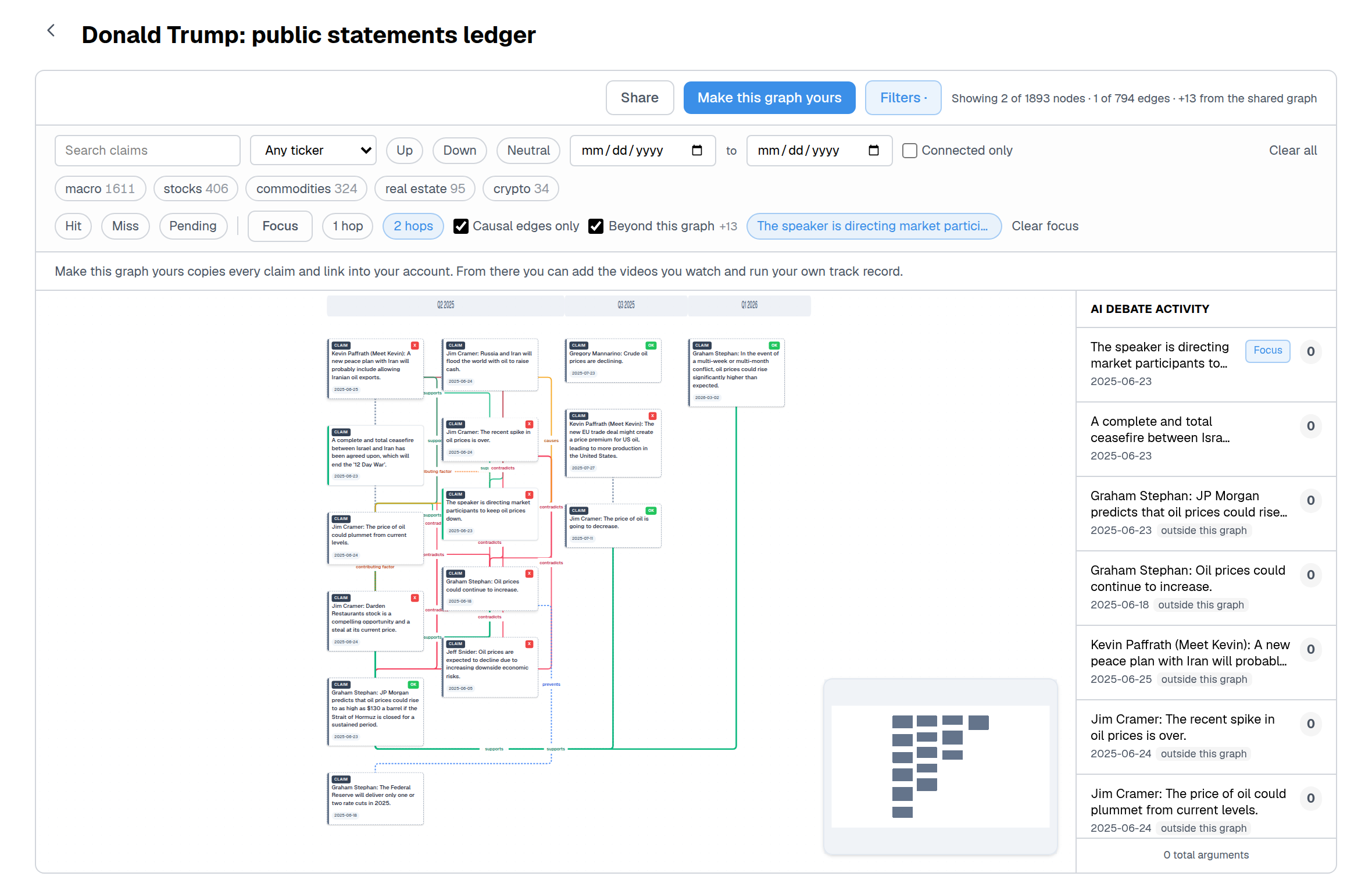
Tap a name to open that speaker’s brain and every scored claim.
Ten of thirteen sit inside the coin-flip range. Trump, scored in his own league because his posts move the markets they are about, hit 49.8%.
What we learned
When: the same words, a different day, a different result
On the morning of Trump’s post, two YouTubers called the index the other way. Gregory Mannarino: “sell America”. Mike Maloney: “we’re still in a hyperbubble”. Both lost. Graham Stephan had made the opposite call the day before; all seven of his buy calls that fortnight hit. On 76 of Trump’s calls a YouTuber took the other side within two weeks. Trump won 31, the YouTubers 20. Timing decided more than conviction.
Still true?: a good record goes stale
Split by topic, a few speakers beat the coin flip on their own subject.
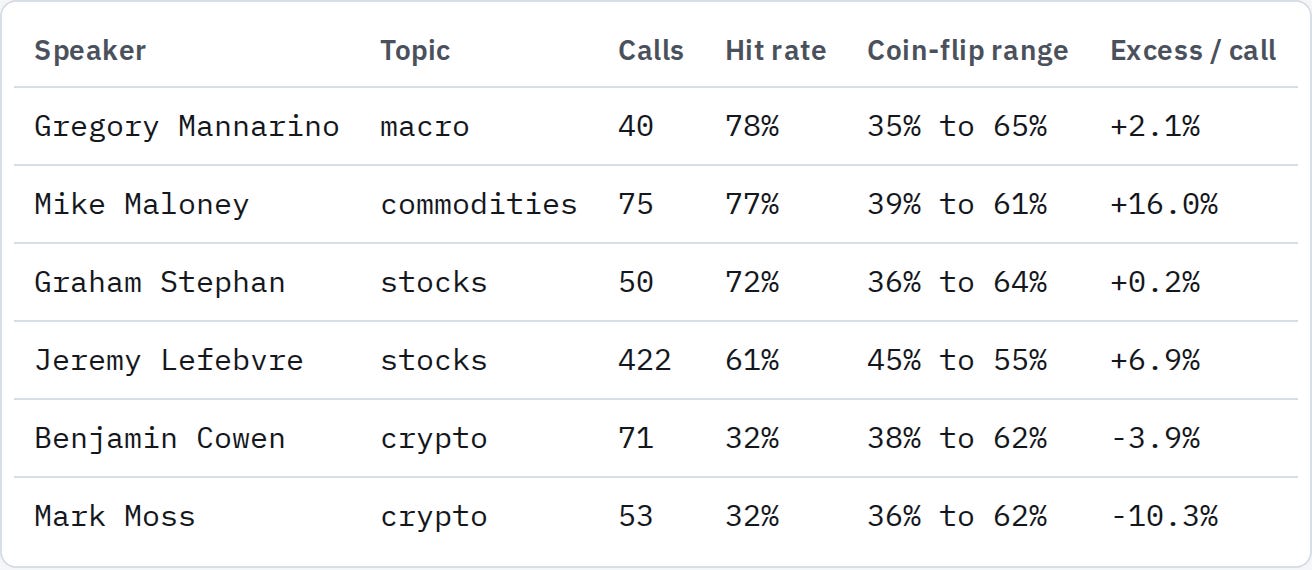
Above the coin flip: Mannarino macro 78%, Maloney commodities 77%, Stephan stocks 72%, Lefebvre stocks 61%. Below: Cowen crypto 32%, Moss crypto 32%.
But the top of the table moves. Jeremy Lefebvre went from 70% to 44% in six months. Mike Maloney from 70% to 19%. A memory that only knows “this person is good” is already out of date.
Why: it wasn’t the person
On 3 July 2025 Jim Cramer called Palantir to 200 while Parkev Tatevosian called it overvalued. Same dates: Cramer plus 28.5%, Tatevosian minus 30.5%. What decided it? For every call we found the series the asset had been tracking for a year, its price driver, and checked whether it moved with the call. That one variable split the same speakers’ calls by 32 points of hit rate. Nobody ever named it.
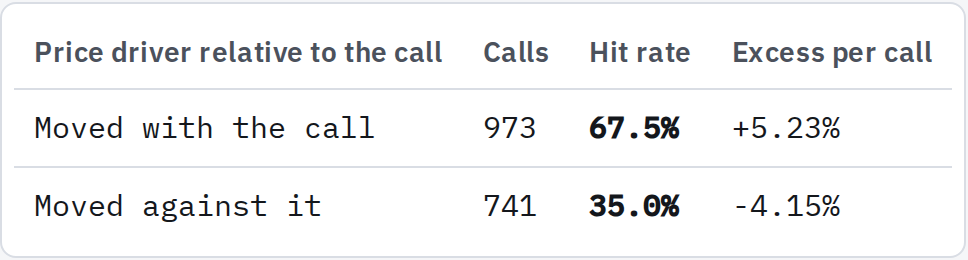
Driver moved with the call: 973 calls, 67.5% hit rate, +5.23% per call. Against it: 741 calls, 35.0%, -4.15%.
Even the direction mattered less than it seems: buying every stock a speaker named, ignoring buy or sell, did better than following them. And “inverse Cramer” would have lost money.

Following the direction: +3.92% per call, 52.8% hit rate. Buying every symbol named: +5.52%, 56.2%.
What a memory with a clock makes possible
Each of those lessons needed the same three things a sentence does not carry: when it was said, why it should be true, and whether it still is. Give memory a clock and an AI can backtest an idea without peeking at the future, explain a result from the evidence of its day, and tell you, “You believed this in March. Three things it rested on have changed since.” That works for investing, and for anything else you believe.
Coming next: talk to a brain, or bring it into your AI
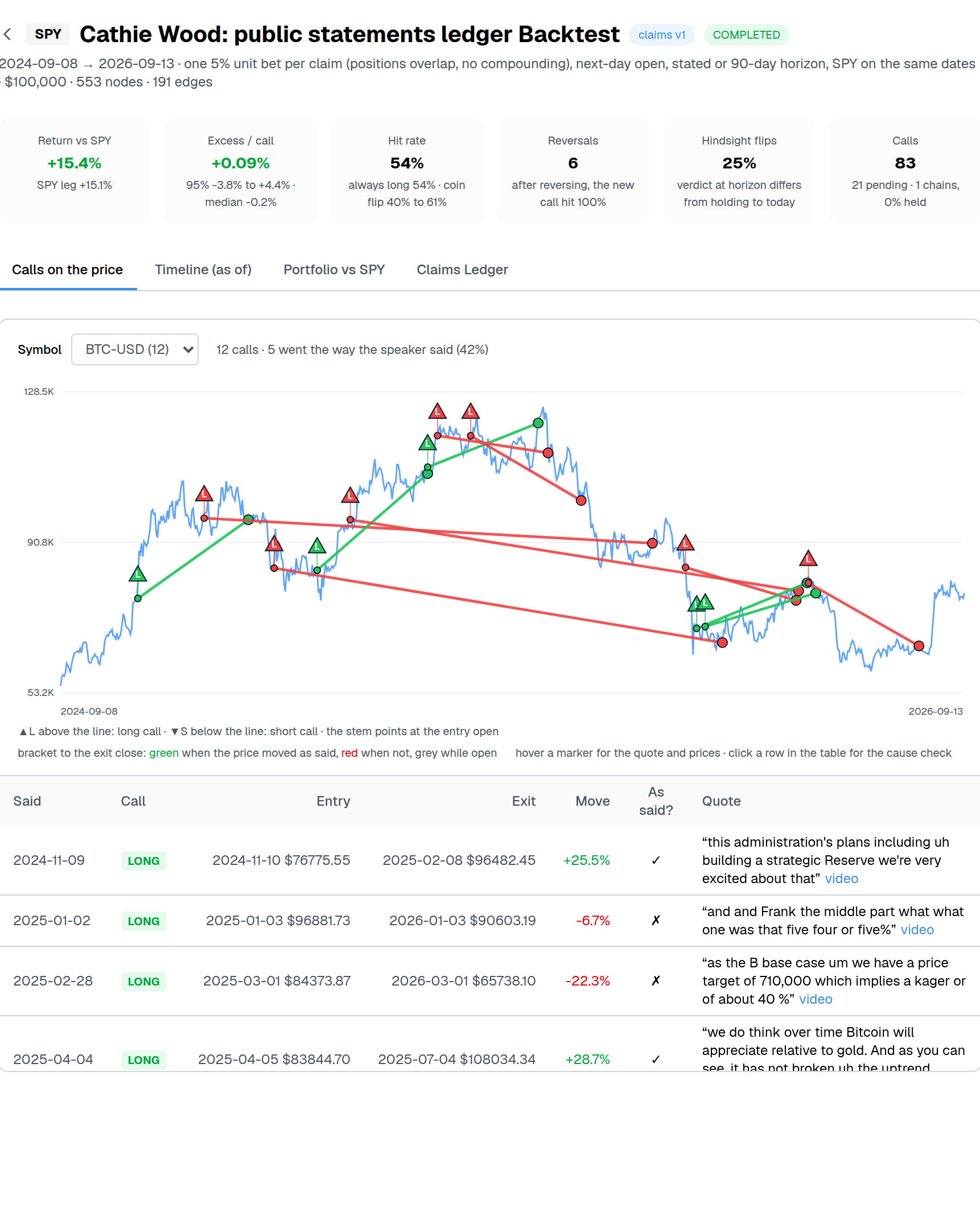
Every brain in this post opens without an account. Over the coming weeks we are rolling out three things on top of them:
Talk to a brain. Ask Trump’s or Cramer’s brain what they said about an asset, when, and how it turned out. Answers come from dated public statements, not from a model’s memory.
Bring it into your AI with MCP. Connect any brain to Claude, ChatGPT or your own agent, so it reads dates and verdicts instead of guessing.
Make a brain for yourself, or your team. Upload your ChatGPT or Claude history and get your own brain, with every belief dated. Then talk to it, share it, or connect it to your AI.
I would love your help. Try them as they open and tell me what works and what doesn’t. Which brain would you talk to first? What would you ask it? Would you connect your own brain to your AI, and what would you want it to remember? Reply to this email or leave a comment. Every answer shapes what we build next.
Limits and right of reply
We scored 13 of the 20 YouTubers we set out to; the rest lacked captions or enough resolved calls. Trump’s posts were found by finance keywords. Claims were extracted by a model and reviewed on a sample. The benchmark is SPY, and the rule was frozen before scoring. The AI experiment used one model on a stratified sample of resolved calls. This is a record of public statements, not investment advice, not a recommendation to follow or fade anyone, and not a political judgment. Anyone listed can request their full claim list; corrections are published, never silently edited.
Keep this going
364 calls are still open and will resolve in the coming months. Tell us in the comments who to score next, or where the rule is wrong; we will run your version and publish it. And when your own brain opens, add what you believed on the morning of 9 April. It gets scored next to everyone else’s at factagora.ai.